What is the community of owners in Spain and what are your obligations?

Fotocasa is the expert real estate portal if you are looking for your home in Spain and want to resolve your doubts about housing

Patricia Andrés
Patricia Andrés Experta en el sector inmobiliario

Promedio de puntuación 3 / 5. Recuento de votos: 1

Hasta ahora, ¡no hay votos!. Sé el primero en puntuar este contenido.

When we buy a property in a building or a residential complex in Spain, we are not just acquiring our own flat. We also become part of a community of owners (comunidad de vecinos). This involves sharing spaces, expenses, and decisions with the rest of the homeowners.

Many people are unsure how a community works, what obligations it entails, or why a monthly fee must be paid. However, understanding this is key to avoiding conflicts and knowing our rights and responsibilities.

At Fotocasa, we review what a community of owners is, who makes it up, how it is organized, and what you should keep in mind if you are a homeowner.

What is a Community of Owners?

A community of owners (comunidad de propietarios or comunidad de vecinos) is the group of owners of dwellings and commercial premises that form part of the same building or residential complex.

It is regulated by the Law on Horizontal Property (Ley de Propiedad Horizontal), published in the BOE (Official State Gazette), which establishes how they should be organized, what obligations owners have, and how decisions are made.

When you buy a flat in a building in Spain, you automatically become a member of the community of owners

The community exists from the moment there are several owners sharing common elements, such as the entrance hall, staircases, or the lift.

Who is part of the community of owners?

The community is made up of all individuals who own a home or commercial premises in the building.

Within the community, we find several key figures:

  • The Owners’ Assembly (Junta de Propietarios), which brings together all the homeowners.

  • The President of the community of owners, who legally represents the community.

  • The Property Manager (Administrador de fincas), if there is one, who handles economic and administrative management.

What is the Owners’ Assembly and how often does it meet?

The Owners’ Assembly is the body where important decisions are made.

The law states that at least one ordinary meeting (junta ordinaria) must be held per year, during which accounts and budgets are approved.

Decisions regarding expenses, building works, or coexistence rules are approved during the Owners' Assembly.

In addition, extraordinary meetings (juntas extraordinarias) can be convened whenever it is necessary to address a specific matter, such as urgent building works.

What is the purpose of the community of owners?

The community serves to manage everything that is common within the building.

Among its main functions are:

  • Maintaining and preserving common elements.

  • Approving budgets and expenses.

  • Organizing building works and repairs.

  • Establishing coexistence rules.

It may also have statutes or internal bylaws (estatutos o normas de régimen interior) that regulate issues such as the use of common areas.

What are common elements and why do they affect you?

Common elements (elementos comunes) are the parts of the building that belong to all the owners.

According to the Law on Horizontal Property (Ley de Propiedad Horizontal), these include, among others:

  • The ground and the building structure.

  • Façades and roofing.

  • The entrance hall, staircases, and corridors.

  • The lift.

  • General installations (water, electricity, etc.).

Even if you do not use the lift, you are still responsible for its maintenance if it is a common element.

Even though they are not inside our home, we are co-owners of them. For this reason, we must contribute to their maintenance.

What obligations do you have as an owner?

By becoming part of the community, we assume several obligations.

The main ones are:

  • Paying the community fee.

  • Contributing to approved special assessments (derramas).

  • Respecting coexistence rules.

  • Not carrying out building works that affect common elements without authorization.

If community fees are not paid, the community can legally claim the debt.

How is the community fee calculated?

The community fee is calculated based on the participation quota (coeficiente de participación) that each home or commercial premises has within the building.

This coefficient appears in the title deed (escritura) and usually depends on the size of the property and its location within the building.

The expenses that the fee may include are, for example:

  • Cleaning services.

  • Electricity for the entrance hall.

  • Lift maintenance.

  • Building insurance.

  • Services such as a concierge/porter, if applicable.

The fee can be paid monthly, quarterly, or annually, as established by the community. Payment of the community of owners’ fee can be done in several ways, although the most common is via direct debit.

What are special assessments (derramas) and when are they mandatory?

Special assessments (derramas) are extraordinary payments approved to cover a specific expense that was not foreseen in the annual budget.

For example, a major repair or building works.
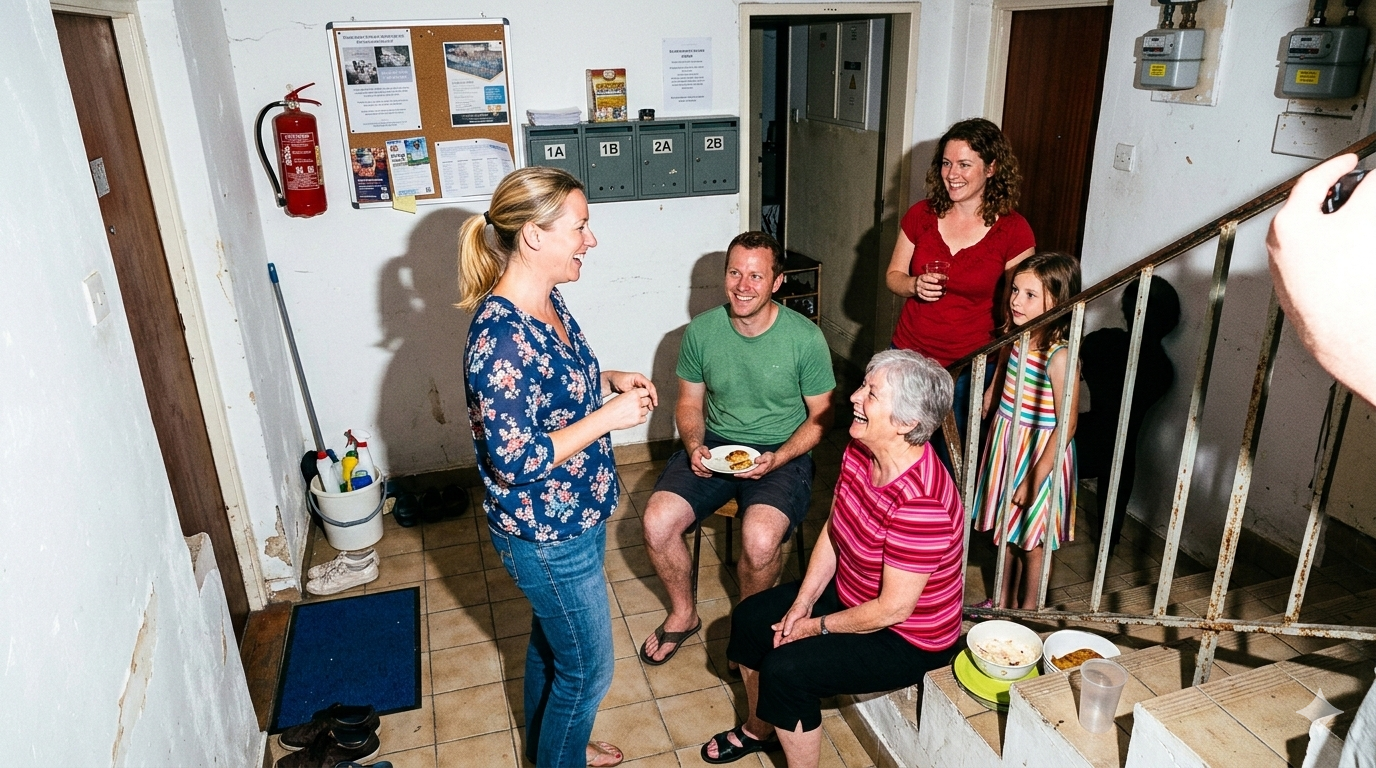
Special assessments (derramas) are one-off payments to cover extraordinary expenses approved by the community.

Not all special assessments are mandatory in every case. It depends on the type of work and how it was approved in the assembly.

How much does the community of owners cost?

The cost of the community depends on many factors:

  • Number of residents.
  • Services included.
  • Whether there is a lift, swimming pool, porter, or common areas.
  • Condition of the building.

There is no fixed amount, although the average community fee in Spain is usually around €100 per month. Each community approves its own annual budget and distributes the expenses according to each owner’s participation quota.

Therefore, before buying a property, it is important to ask what the monthly fee is and if there are any planned special assessments (derramas).

What can and can’t you do when living in a community?

Living in a community involves coexisting with other people and respecting certain limits.

As an owner, you can:

  • Use common elements according to their purpose.

  • Participate in the Owners’ Assemblies.

  • Vote on decisions.

But you cannot:

  • Carry out works that affect common elements without authorization.

  • Modify façades or structures without permission.

  • Use common areas improperly.

Do I have to pay the community fee if I don’t live in the building?

Yes. If you are an owner, you must pay the community fee even if you do not live in the flat.

It does not matter if:

  • You are living in another city or abroad.
  • The flat is rented out.

  • You do not use the lift or the common areas.

The obligation arises from being an owner, not from residing in the property.

The community fee does not depend on whether we live in the property, but on the fact that we are its owners.

Furthermore, even if we do not reside in the building, we continue to be part of the community. This means that:

The Law on Horizontal Property establishes that the role of president must be held by an owner; therefore, the fact of living elsewhere does not automatically exclude us.

What happens if the flat is rented out?

If we rent out the property, in principle, the obligation to pay the community fees remains with the owner.

However, the rental contract may establish that the tenant assumes the payment of certain community expenses. For this to be valid, it must be expressly agreed upon in the contract.

In any case:

  • Regarding the community, the owner remains the responsible party.

  • The tenant is a resident, but is not part of the community as a co-owner.

  • The right to attend and vote in the assembly belongs to the owner.

The tenant, for their part, must respect the rules of coexistence established by the community of owners.

Being part of a community of owners is a standard situation when living in a building. Understanding how it works, what expenses it involves, and what our obligations are helps us avoid problems and live better with the rest of the owners.

At Fotocasa, we have an excellent team of professionals dedicated to creating relevant content for our readers. If you enjoyed this article, we would be delighted if you published it on your website. In that case, please remember to credit Fotocasa as the original source. Thank you for your support.

Editorial Integrity of Fotocasa Life

0 Comentarios
Más antiguo
El mas nuevo
Comentarios en línea
Ver todos los comentarios