What time do people eat in Spain?
| Time of day |
Approximate schedule |
What does it consist of? |
| First Breakfast |
07:00 – 09:00 |
Something light at home (coffee with biscuits or toast). |
| Mid-morning Snack (Almuerzo) |
10:00 – 11:30 |
Workers head out to cafes. This is the time for bread with tomato, a slice of potato omelet, or churros with chocolate. |
| Aperitif |
12:00 – 14:00 |
Especially on weekends. People have a beer or a vermouth with light bites before lunch. |
| Lunch (Comida) |
14:00 – 15:30 |
The main meal of the day. Restaurants offer the famous Menu of the Day (Menú del Día). |
| Afternoon Snack (Merienda) |
17:00 – 18:30 |
Very popular, especially among children after finishing school. People usually have a small sandwich or a mid-afternoon snack. |
| Dinner |
21:00 – 23:00 |
Lighter than lunch. In summer or on weekends, it can easily be delayed past 23:00. |
Restaurant tip: In many places, especially outside tourist areas, restaurant kitchens close between 16:00 and 20:00. If you try to have dinner at 18:00 or 19:00, you will most likely find everything closed or only be offered coffee.
3. Is it true that people take a siesta in Spain?
No, the idea that everyone in Spain takes a siesta is a myth. There is an international stereotype that the whole of Spain stops to sleep after lunch. Current reality is more nuanced:
- In large cities and corporate offices, professional life runs continuously. The lunch break usually lasts 1 hour, making the siesta practically an unfeasible myth.
- In towns and small cities, especially during the hot summer, the midday break (from 14:00 to 17:00) remains very much alive. Businesses close and the streets empty out, but not necessarily for sleeping—rather to seek shelter from the sun, eat with family, and rest before resuming the workday into the evening.
4. What are the public and bank holidays in Spain?
Spain features public holidays where commercial and work activity stops almost completely. These are the mandatory national holidays for 2026, but you must keep in mind that, additionally, each autonomous community and each municipality has its own local holidays:
- 1 January: New Year’s Day
- 6 January: Epiphany (Three Kings’ Day)
- 3 April: Good Friday
- 1 May: Labour Day
- 15 August: Assumption of Mary
- 12 October: National Day of Spain
- 1 November: All Saints’ Day
- 8 December: Immaculate Conception
- 25 December: Christmas Day
5. How to integrate into local customs and community life in Spain?
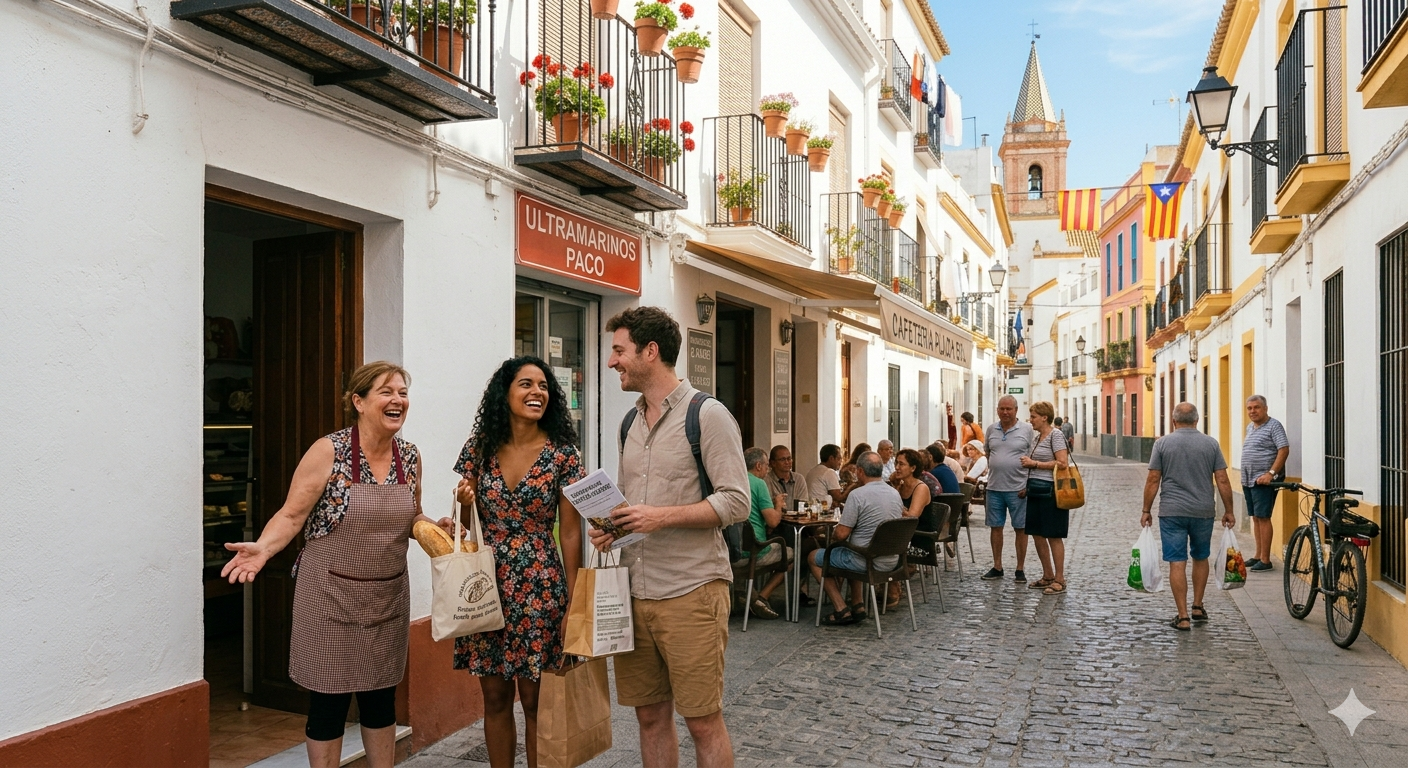
Spanish culture is oriented toward the outdoors. Community life takes place in squares, terraces, cafes, and local markets.
- Everyday greetings: when entering a small shop, a bakery, or a lift, it is a basic rule of courtesy to say “¡Hola, buenos días!” or “Buenas tardes”, and say goodbye with a “Gracias, ¡adiós!”.
- Physical contact and tone of voice: conversations are usually expressive, lively, and in a loud tone of voice. Light physical contact or speaking at a closer distance is normal and denotes warmth. Interruptions during a conversation often reflect enthusiasm for the topic, not bad manners.
- The “Sobremesa”: when dining with locals, do not get up immediately after dessert. The sobremesa is the custom of staying around the table sharing conversation, coffee, or drinks for an hour or more after finishing the meal.
6. What is the housing market like in Spain?
A vital aspect of landing in the country is the home search. When looking for a flat, always compare housing prices carefully and consult with established local estate agencies.
How much it costs to buy a house in Spain
| Balearic Islands |
€5,441 |
€435,310 |
| Madrid |
€5,410 |
€432,808 |
| Basque Country |
€3,925 |
€314,006 |
| Catalonia |
€3,418 |
€273,412 |
| Canary Islands |
€3,374 |
€269,891 |
| Spain (Average) |
€3,133 |
€250,673 |
| Andalusia |
€2,990 |
€239,206 |
| Valencian Community |
€2,873 |
€229,822 |
| Cantabria |
€2,746 |
€219,696 |
| Navarre |
€2,386 |
€190,843 |
| Asturias |
€2,378 |
€190,218 |
| Galicia |
€2,261 |
€180,857 |
| Murcia Region |
€2,191 |
€175,248 |
| Aragon |
€1,948 |
€155,878 |
| La Rioja |
€1,938 |
€155,068 |
| Castile and León |
€1,816 |
€145,281 |
| Castile-La Mancha |
€1,407 |
€112,595 |
| Extremadura |
€1,352 |
€108,178 |
Source: Fotocasa, data updated to June 2026
The average price of buying a home in Spain in June 2026 is €3,133/m2 (around €250,673 for an 80 m2 property), according to Fotocasa data. This price varies significantly depending on the autonomous community. The Balearic Islands and Madrid are the most expensive regions, with housing prices at €5,441/m2 (€435,310 for an 80m2 property) and €5,410/m2 (€432,808 for an 80m2 property) respectively.
How much it costs to rent a home in Spain
| Madrid |
€21.96 |
€1,756.80 |
| Catalonia |
€19.30 |
€1,544.00 |
| Balearic Islands |
€19.10 |
€1,528.00 |
| Basque Country |
€17.55 |
€1,404.00 |
| Canary Islands |
€16.28 |
€1,302.40 |
| Valencian Community |
€14.79 |
€1,183.20 |
| Spain (Average) |
€14.76 |
€1,180.80 |
| Cantabria |
€13.78 |
€1,102.40 |
| Navarre |
€12.85 |
€1,028.00 |
| Andalusia |
€12.38 |
€990.40 |
| Asturias |
€12.26 |
€980.80 |
| Aragon |
€11.98 |
€958.40 |
| Galicia |
€10.74 |
€859.20 |
| Murcia Region |
€10.68 |
€854.40 |
| La Rioja |
€10.27 |
€821.60 |
| Castile and León |
€10.24 |
€819.20 |
| Castile-La Mancha |
€9.09 |
€727.20 |
| Extremadura |
€7.57 |
€605.60 |
Source: Fotocasa, data updated to May 2026
Renting a home in Spain, on the other hand, costs on average €14.76/m2, around €1,180.80 for an 80m2 property, according to Fotocasa data updated in May 2026.
Conducting a rigorous market study will not only protect you from paying an inflated or unbalanced price, but it also helps prevent speculation and avoids contributing to the disproportionate rise in rental prices in traditional neighborhoods, something that local residents in your new community will greatly appreciate.
On portals like Fotocasa you will be able to find thousands of homes, get to know the market, and compare prices.
7. Is it necessary to learn Spanish if you want to move to Spain and integrate into your neighborhood?
Although more and more people speak English in tourist areas and large international cities, learning Spanish is essential if you want to truly integrate. Mastering the language is not only key out of politeness and respect toward your host country, but it is indispensable for sorting out daily bureaucracy, looking for a rental, visiting the doctor, and building real relationships with your neighbors.

![How much does it cost to buy a house in Spain? [2026]](https://www.fotocasa.es/fotocasa-life/wp-content/uploads/2020/01/How-much-does-it-cost-to-buy-a-house-in-Spain-355x230.png)



 Your home in Spain