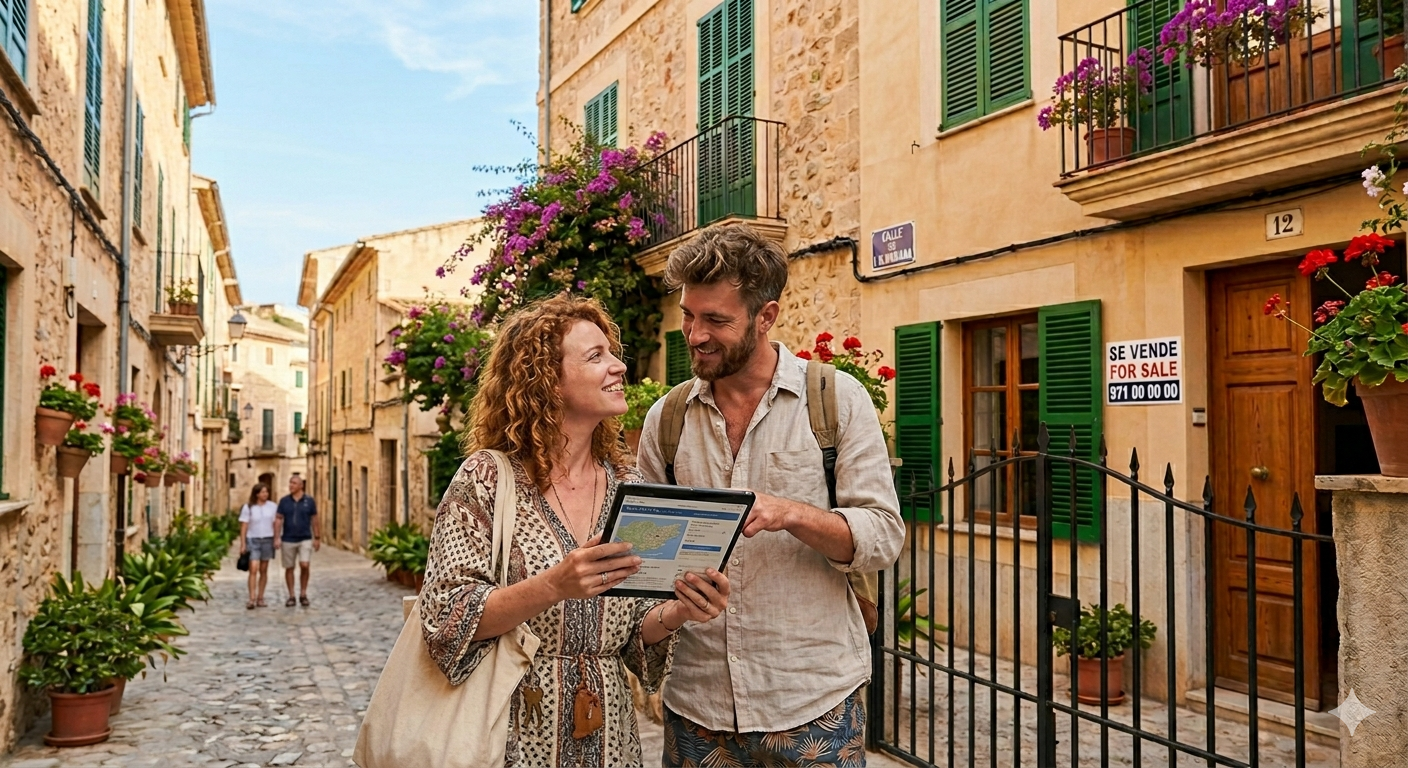

Are there limitations for foreigners buying property in Mallorca in 2026?

Fotocasa is the expert real estate portal if you are looking for your home in Spain and want to resolve your doubts about housing

Patricia Andrés
Patricia Andrés Experta en el sector inmobiliario

Promedio de puntuación 4 / 5. Recuento de votos: 1

Hasta ahora, ¡no hay votos!. Sé el primero en puntuar este contenido.

  • In February 2026, the Balearic Parliament rejected the initiative to restrict non-residents from buying properties.
  • The Balearic Islands led property purchases by foreigners, accounting for 28.9% of transactions in the final quarter of 2025, according to data from the College of Registrars.
  • EU regulations and the rejection of the bill ensure complete freedom for foreigners looking to buy real estate in Mallorca.

According to official data from the College of Property Registrars, the Balearic Islands led home sales to foreigners, capturing 28.9% of all transactions in the region (data from the final quarter of 2025).

In response to this high international demand, a regional bill was recently proposed with the aim of restricting these real estate operations.

At Fotocasa, we analyze exactly what happened to this initiative and how the real estate market in Mallorca is regulated this year. In this article, we review the legislative changes debated in the archipelago, the weight of the international buyer, and the current steps to purchase a property in Mallorca as a foreigner.

What are the rules currently regulating real estate transactions for foreign citizens on the island?

Are there any limitations for foreigners buying property in Mallorca in 2026?

As of today, there is no legal ban or restrictions for foreigners looking to buy property in Mallorca. Anyone, regardless of their origin or residency status, can purchase a property 100% legally throughout the Balearic archipelago.

The social debate regarding the housing crisis reached the institutions early this year. However, the legislative proposal aimed at restricting the sale of residential properties was officially rejected by Parliament in 2026. Therefore, the international real estate market continues to operate as normal.

What did the bill propose to restrict property purchases by foreigners in the Balearics?

The initiative presented to the Balearic Parliament sought to enable local councils to apply temporary restrictions in municipalities where the real estate market was particularly strained. The purpose was to ensure that the residential stock primarily served a housing function for the local population.
The proposal suggested a temporary ten-year veto for buyers without prior residency, but it was dismissed as it was considered legally unfeasible within the European framework.

The rejected regulations included three specific types of restrictions:

  • Residency veto: It required proving roots in the islands with a habitual residence of at least three years to be able to acquire a home.
  • Curbs on corporations: It limited the purchase of residential properties by legal entities and investment funds.
  • Second home control: It established restrictions linked to the purchase of properties for holiday or non-primary use.

Does European Union regulation allow restrictions on property purchases by foreigners in Mallorca?

The main barrier to implementing limitations for foreigners buying property in Mallorca is the Treaty on the Functioning of the European Union. Specifically, its Article 63 explicitly prohibits any restrictions on capital movements and payments between Member States, classifying the purchase of real estate as a capital movement.

There are certain territories in Europe that apply restrictions, such as Denmark, Malta, or the Åland Islands, but they constitute unique exceptions. These places have specific protocols that were directly negotiated and agreed upon in their accession treaties to the European Union. Modifying the current regime in Spain would require top-level political negotiation with the European Commission to recognize a specificity that the islands do not currently possess.

What are property prices in Mallorca in 2026?

The average property price in the Balearic Islands in May 2026 is €5,359 per square meter, which represents a cost of €428,725 for a standard 80 m² home, according to data from Fotocasa. This places it as the second autonomous community with the highest prices in Spain, behind only Madrid.

The real estate market in the archipelago maintains a steady growth trend, with a year-on-year increase of 6.6%.

The Balearic Islands rank as the autonomous community with the second highest prices in Spain, exceeding 5,350 euros per square meter. This explains the intense social debate that has arisen around housing affordability for traditional residents.

If we analyze Mallorca, we find very significant differences depending on the selected locality. For example, in Palma de Mallorca, the property price in May 2026 stands at €5,225/m², which is equivalent to an average cost of €418,020 for an 80-square-meter apartment, according to data from Fotocasa. However, localities with an exclusive profile such as Calvià or Andratx record much higher values, reaching €7,415/m² (€593,169 for 80 m²) and €7,344/m² (€587,531 for an 80 m² property) respectively.

Property Prices by Municipality in Mallorca (2026)

Municipality (Mallorca) Monthly Price (€/m²) 80m² Property
Calvià 7,415 € 593,169 €
Andratx 7,344 € 587,531 €
Campos 6,839 € 547,121 €
Palma de Mallorca 5,225 € 418,020 €
Ses Salines 5,001 € 400,062 €
Capdepera 4,524 € 361,949 €
Alcúdia 4,314 € 345,087 €
Llucmajor 4,235 € 338,778 €
Son Servera 3,911 € 312,870 €
Manacor 3,153 € 252,218 €
Inca 3,023 € 241,810 €

Source: Price data from the Fotocasa Real Estate Index, May 2026.

What requirements must a foreigner meet to buy a house in Mallorca in 2026?

Since no limitations have been approved for foreigners buying property in Mallorca, the legal and administrative process for international buyers follows the same channels as for a Spanish citizen.

Non-resident individuals who wish to formalize the purchase of a property in Spain must follow these mandatory steps:

  1. Process the NIE: This is the Foreigner Identification Number, which is essential for signing contracts, opening local bank accounts, and settling the corresponding taxes.
  2. Have a larger down payment: If requesting financing from a bank in Spain, the criteria for non-residents are usually stricter, typically financing between 60% and 70% of the apartment’s value.
  3. Sign the public deed: The transaction must be formalized before a notary, who is responsible for checking that all documentation is in order and complies with Spanish law.
  4. Register the property: The final step consists of registering the home in the Property Registry to officially establish the ownership of the new owner.

It is important to remember that, since April 2025, the Government of Spain eliminated the granting of residence permits (Golden Visa) linked directly to real estate investments, so buying a house no longer grants the right to automatic residence to citizens from outside the European Union.

As of today, it seems unlikely that measures to restrict property purchases by foreigners in Mallorca will be implemented.

Despite proposals for housing regulation, the Balearic Islands market remains open and regulated under the European principle of free movement of capital, meaning that acquisition requirements remain strictly commercial and fiscal.

Are you thinking of buying a home in Mallorca? Read our article: Buying a house in the Balearic Islands: guide to islands and best towns

At Fotocasa, we have an excellent team of professionals dedicated to creating relevant content for our readers. If you enjoyed this article, we would be delighted if you published it on your website. In that case, please remember to credit Fotocasa as the original source. Thank you for your support.

Editorial Integrity of Fotocasa Life

0 Comentarios
Más antiguo
El mas nuevo