Do foreigners pay more taxes when buying a house in Spain?

Fotocasa is the expert real estate portal if you are looking for your home in Spain and want to resolve your doubts about housing

Patricia Andrés
Patricia Andrés Experta en el sector inmobiliario

Promedio de puntuación 3 / 5. Recuento de votos: 1

Hasta ahora, ¡no hay votos!. Sé el primero en puntuar este contenido.

If we are thinking about buying a home in Spain and we are not Spanish, it is normal to ask ourselves this question: will we pay more taxes for being foreigners?

In recent months, moreover, there has been talk of possible new tax measures aimed at non-resident buyers, which has generated even more doubts.

The first thing we must be clear about is that nationality does not determine the taxes we pay when buying a home in Spain. What can influence it is our tax residence and the intended use of the property.

At Fotocasa, we review what changes and what does not change when buying a house in Spain as a foreigner, and what expenses we should anticipate before and after the purchase.

Do foreigners pay more taxes when buying a house in Spain?

The general answer is no.

The taxes for buying and selling property are the same for foreigners and for Spanish citizens.

If we buy a home in Spain, we will have to pay the taxes corresponding to the type of property, just like any other buyer. Generally speaking, taxes directly linked to the transaction usually represent between an additional 10% and 12% on top of the purchase price.

Foreigners pay the same expenses and taxes to buy a home as nationals

The difference lies not in nationality, but in whether or not we are tax residents in Spain, something that can have implications after the purchase, as we will have to pay some additional taxes.

Furthermore, if we want to buy our home from abroad without coming to Spain, we will have to add some additional expenses such as signing a power of attorney or obtaining certified translations.

What taxes do we pay when buying a home?

The tax depends on the type of property we buy (whether it is new build or resale).

Taxes if we buy a resale property

VAT is not paid on a used home. The main tax is the ITP (Property Transfer Tax), which levies the transfer between individuals.

The ITP changes depending on the autonomous community and usually ranges between 6% and 10% of the purchase price, although in some communities it can reach up to 13% for higher-value properties. In addition, there may be tax reliefs in certain situations.

If we buy a property for €100,000, we would pay:

  • 6% → €6,000
  • 10% → €10,000

In other words, the ITP can represent several thousand additional euros over the agreed price.

If we buy a new build property

If we want to buy a new build property, in this case VAT (IVA) is payable. The general rate is 10% of the sale price.

For example, if we acquire a home for €100,000, we must pay €10,000 in VAT.

New build properties are subject to VAT (IVA) at a rate of 10%, and AJD (Stamp Duty) can add up to an additional 1.5% to the price.

Additionally, IAJD (Stamp Duty) is paid for the formalization of the deed and its registration in the Land Registry. This tax is usually between 0.5% and 1.5% of the property price.

For a home worth €100,000, this would mean an additional €500 to €1,500.

It is important to keep in mind that if we apply for a mortgage, the IAJD is covered by the bank. If we buy in cash, we will pay it ourselves.

What other expenses should we anticipate when buying?

In addition to taxes, the sale involves a series of necessary expenses to formalize the operation.

  • Notary fees: these depend on the value of the home and the number of copies of the deed. They usually represent between 0.2% and 0.5% of the property price. If we buy for €100,000, we would pay approximately between €200 and €500.
  • Land Registry (Registro de la Propiedad): this is the cost we must bear to register the property in our name. It is calculated in brackets based on the value declared in the public deed. In the case of a €100,000 home, the cost would be €133, although it changes if the value is higher.
  • Appraisal fees: if we request financing, an official property appraisal will be mandatory, the cost of which usually ranges between €250 and €600.

These amounts do not depend on whether we are foreigners or not, but on the value of the home and whether we need a mortgage.

What if we cannot travel to Spain to sign?

In the case of foreign buyers, circumstances may arise in which we cannot travel to Spain to sign the deed. In that case, we will have to grant a power of attorney.

A power of attorney is a public document authorized before a notary through which we authorize another person to act on our behalf. In a sales operation, it can be used to sign the deed before a notary, carry out procedures at the Land Registry, or perform tasks directly linked to the transaction.

The cost of a power of attorney is not fixed, but as a guideline, it is usually between €25 and €100, depending on its content.

Furthermore, if we need to carry out certified translations of documentation, this will be another additional expense that we must anticipate before closing the operation.

Is there really a 100% tax for foreigners?

In recent years, there has been talk of the possibility of applying a 100% supplementary tax to certain non-resident foreign buyers.

However, it is important to clarify that as of today, there is no 100% tax approved and in force in Spain.
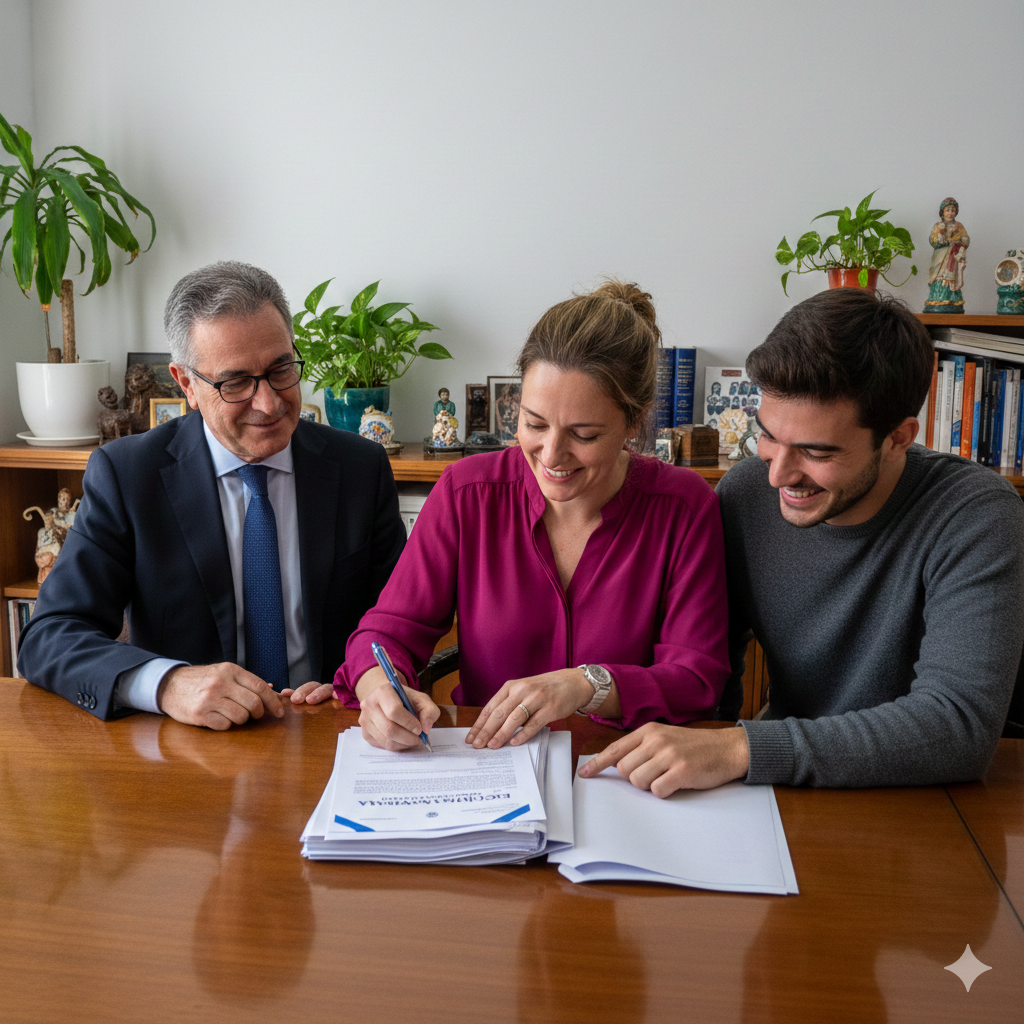

The so-called 100% tax is a debated proposal, but it is not currently in force.

The proposals that have appeared in the public debate have focused primarily on non-EU buyers who are not tax residents in Spain. Furthermore, it would not apply to new build homes subject to VAT.

For such a measure to come into effect, it would have to be formally approved and pass various legal procedures. At this moment, purchases made by foreigners remain subject to the same basic taxes (ITP or VAT + AJD) as any other transaction. In the event that it were approved, there would indeed be differences between what foreigners pay when buying a house and what residents pay.

What expenses will we have each year as owners?

Once the property is purchased, being an owner involves taking on a series of recurring expenses, regardless of our nationality.

  • The IBI (Property Tax) is a mandatory municipal tax paid every year for being an owner. Its amount depends on the cadastral value of the property and the tax rate set by each town hall, and it usually ranges between 0.4% and 1.3% of the cadastral value. For a €100,000 home, we could pay between €400 and €1,300 per year, depending on the municipality.
  • The rubbish collection tax (tasa de basuras) finances the waste collection service. The average annual cost is around €116 per household, although it can vary by location and, in some municipalities, it is included in the IBI bill.
  • If the property is part of a community of owners, we will have to pay community fees, which are usually around €100 per month, intended for the maintenance of common areas, elevators, or cleaning. Additionally, extraordinary levies (derramas) may be approved for specific works, such as facade renovation or elevator installation.
  • We must also account for basic utilities (electricity, water, gas, and Internet), which can range between €130 and €250 per month, depending on consumption and the property.
  • Home insurance is not mandatory in all cases, but it is recommended to protect the home against damage or unforeseen events. The average price is around €250 per year, although it varies according to coverage and the type of property.

What if we are not tax residents in Spain?

If we do not reside fiscally in Spain, in addition to the previous expenses, we must take into account the Non-Resident Income Tax (IRNR).

This tax is not paid upon purchase, but every year for the fact of being an owner without tax residence in Spain.

If the property is rented out, the IRNR taxes the income obtained:

  • 19% for residents in the European Union, Iceland, or Norway.
  • 24% for the rest of the countries.
The IRNR is an annual obligation for non-resident foreigners, even if the property does not generate real income.

If the property is not rented out, the regulations consider that there is an imputed income, calculated based on the cadastral value of the property. This theoretical income is usually 1.1% or 2% of the cadastral value, depending on the case, and the corresponding tax rate is applied to it.

In both cases, the tax is declared using Model 210 and is mandatory for non-resident owners.

This would be, as of today, the additional expense we would have to face if we buy a home in Spain as non-resident foreigners.

At Fotocasa, we have an excellent team of professionals dedicated to creating relevant content for our readers. If you enjoyed this article, we would be delighted if you published it on your website. In that case, please remember to credit Fotocasa as the original source. Thank you for your support.

Editorial Integrity of Fotocasa Life

0 Comentarios
Más antiguo
El mas nuevo
Comentarios en línea
Ver todos los comentarios