What are the opening dates and rules for community pools in Spain in 2026? Complete guide

Fotocasa is the expert real estate portal if you are looking for your home in Spain and want to resolve your doubts about housing

Patricia Andrés
Patricia Andrés Experta en el sector inmobiliario

Promedio de puntuación 4 / 5. Recuento de votos: 1

Hasta ahora, ¡no hay votos!. Sé el primero en puntuar este contenido.

  • Community swimming pools in Spain are regulated simultaneously by Royal Decree 742/2013, the Horizontal Property Law (LPH), regional regulations, and the estate’s own bylaws.
  • The mandatory requirement to hire a lifeguard and the opening dates depend on each autonomous community, varying according to the number of homes, capacity, or the square meters of the pool basin.
  • The average maintenance cost of a community pool ranges between €600 and €1,200 per year according to the OCU, a mandatory expense for all owners regardless of whether they use the facility or not.

Buying or renting a home in a residential development with a pool is a highly sought-after option to improve quality of life. However, before deciding on a property with a community pool, it is important to know the regulations for its use to avoid penalties and ensure harmonious coexistence.

At Fotocasa, we explain in detail the technical functioning and the most common rules for community swimming pools in Spain to answer all your questions for this 2026 summer season.

What are the most common opening dates and hours in Spain for community swimming pools?

What laws and regulations govern community swimming pools in Spain in 2026?

If you are going to buy a house with a community pool, you should know that for a community swimming pool to be legal in Spain, it must simultaneously comply with four regulatory levels: state, regional, municipal, and the estate’s own rules.

At a national level, Royal Decree 742/2013 establishes the basic technical and sanitary conditions, setting strict parameters such as a water pH between 7.2 and 8.0.

For its part, the Horizontal Property Law (LPH) regulates the financial and coexistence aspects, determining in its article 9.1.e the obligation to cover the maintenance of this common element.

The Autonomous Communities and City Councils are responsible for the operational details of safety, health, and opening licenses.

Finally, the community of owners is responsible for deciding most of the rules for pool use (schedules, opening dates, access, etc.).

Pool regulations can vary depending on the autonomous community. Most rules regarding pool use, such as schedules, access restrictions, etc., are decided through the Community of Owners' Bylaws.

Who sets the community pool rules, and how are they chosen?

The specific rules for the daily use of the pool are approved and determined by the community of owners through their Bylaws or internal regulations. Protected by Article 6 of the Horizontal Property Law, owners have the power to regulate the details of neighborhood coexistence and the proper use of common services.

Community decisions made during meetings are binding for all residents as long as they are not legally modified.

Any change, restriction, or establishment of a new framework for use (such as setting the months of the season or dress code) must be formally debated. For this purpose, a meeting of owners is called where the proposal is discussed and put to a vote, requiring a simple majority of those attending to be officially recorded.

What are the hours for community swimming pools in Spain?

The opening and closing hours of community swimming pools are decided individually at neighborhood meetings to guarantee rest. As a general rule, communities set swimming hours between 08:00 and 22:00 as a maximum limit.

Internal regulations usually prohibit night access to avoid annoying noise. In addition, the administration must plan for and include specific intervals within the schedule dedicated exclusively to water cleaning and treatment tasks.

When do community swimming pools open?

Opening dates are not fixed by law, but are decided by each community of owners at their neighborhood meetings. The usual calendar in Spain begins at the end of May or beginning of June and ends in mid-to-late September.

According to Article 6 of the Horizontal Property Law (LPH), the board establishes the calendar through internal regulations. Even if there are heatwaves, it is legal for a community to decide not to open the pool if the agreement was voted on correctly. This usually happens due to maintenance costs, technical problems, or a lack of consensus among owners.

Can I bring visitors or guests to the community pool?

The answer is: it depends. The possibility of accessing the premises with family or friends from outside the estate is explicitly regulated by the Community Bylaws. These are the 3 most common regulations governing guest entry into community pools:

  • No restrictions: if the Bylaws do not specify any prohibition, guests are allowed as long as they respect the capacity limit and do not hinder the use of other neighbors.
  • Absolute prohibition: access is completely restricted for anyone from outside the development, except for exceptional cases of family members staying temporarily in the home (after consulting the president).
  • Maximum allowance: the community determines a limit on the number of passes or invitations per home (for example, two guests) to control overcrowding, a task usually delegated to the lifeguard.

What is the maximum capacity of community pools, and what age restrictions apply?

The maximum permitted capacity in the swimming area varies according to the space and dimensions of the facilities, although most internal regulations set it at a maximum of 75% of total capacity.

Regarding age, general legislation leaves a legal vacuum, but community custom prohibits children under 14 from using the pool unless they are accompanied and supervised at all times by a responsible adult.

Are pets allowed in community swimming pools?

As a general rule, pets are prohibited from entering the facilities and lawn of community pools for hygiene reasons. However, some autonomous communities or estates allow exceptions if approved internally. In those cases, animals must remain leashed, accompanied by their owner, not be dangerous, and not dirty the common area.

Is it mandatory to hire a lifeguard for the community pool?

There is no single state obligation requiring the presence of a lifeguard; competence is delegated to the Autonomous Communities and City Councils. Each region autonomously sets its own criteria for mandatory requirements based on the number of homes, capacity, or the surface area of the water:

  • Valencian Community: a lifeguard becomes mandatory in complexes with 20 or more homes under previous regulations, or when they exceed 100 homes or a capacity of 100 people according to the specific regional regulation.

  • Community of Madrid: it becomes mandatory to have this professional if the residential complex exceeds 30 homes.

  • Andalusia: the obligation is triggered by size, requiring one lifeguard per pool basin if the water surface area exceeds 200 square meters.

  • Galicia, Cantabria, Basque Country, and Navarre: they require the presence of a lifeguard in communities with more than 20 homes.

  • Catalonia, Balearic Islands, Castile and León, and Murcia: community swimming pools are not considered public, remaining exempt unless they exceed certain local capacity or size thresholds.

In relation to technical safety, the Technical Building Code (CTE), in its section dedicated to drowning risk, dictates that the maximum depth for adults must not exceed 3 meters and 50 centimeters for children. Stairs must have non-slip steps, be free of sharp edges, and not project from the wall of the pool basin.

What are the maintenance costs for a community swimming pool in 2026?

The annual cost of maintaining a medium-sized community pool typically ranges between €600 and €1,200 per year, according to data published by the Organization of Consumers and Users (OCU). This annualized investment is broken down and prorated monthly within each owner’s community fees (divided among all owners). This includes expenses such as chemical products for water treatment, basic utilities (water, electricity, etc.), public liability insurance, etc. To these maintenance costs, potential extra assessment fees (derramas) in case of repairs, etc., must be added.
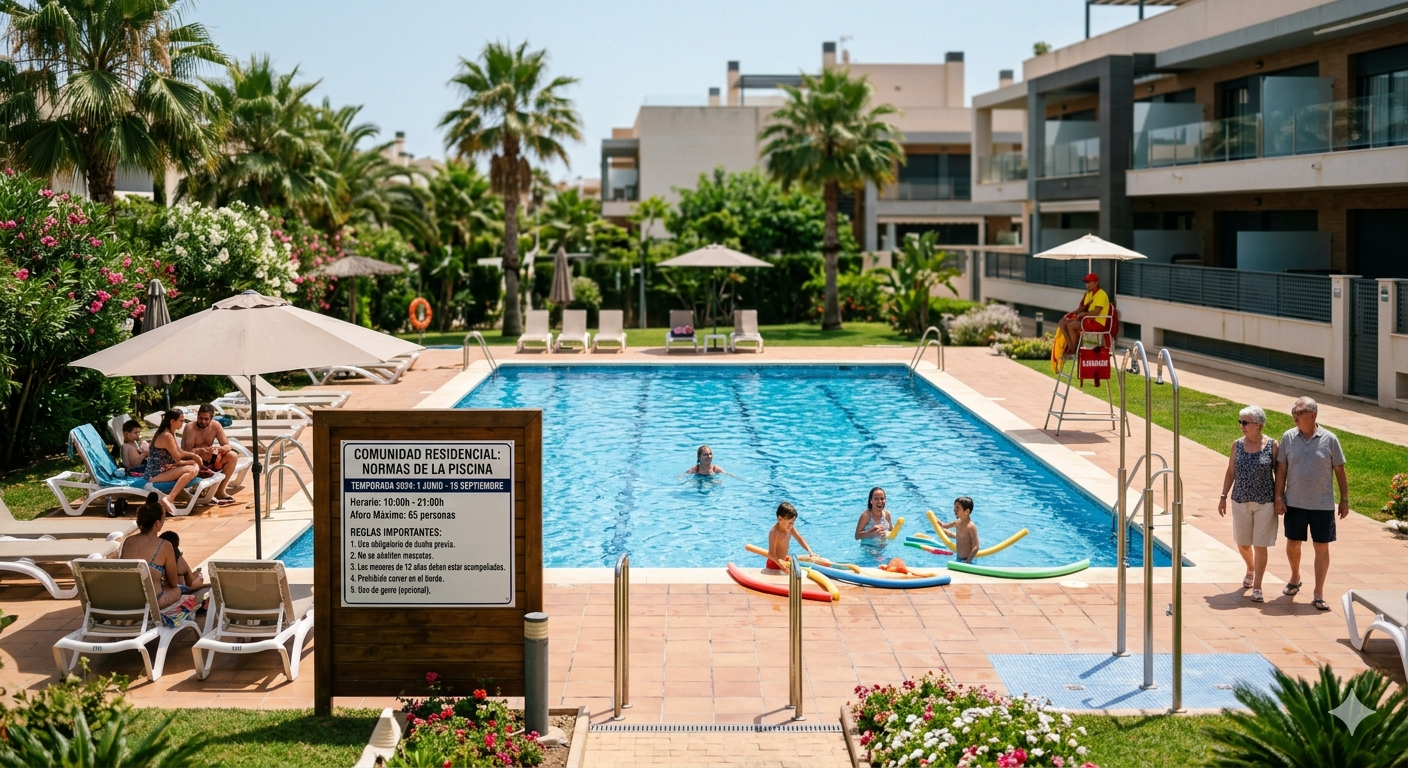

Maintaining a community pool costs between €600 and €1,200 a year

Furthermore, at Fotocasa we remind you that having a built-in swimming pool increases the cadastral value of the property, which directly translates into an increase in the Property Tax (IBI).

Do I have to pay the pool fee if I don’t use it?

Yes, the financial contribution is mandatory. Article 9.1.e) of the Horizontal Property Law dictates that each co-owner has the duty to contribute to the general expenses necessary for the proper maintenance of the property and its services. As it is a common service that cannot be individualized, the payment obligation arises from the status of co-owner of the estate and not from its actual enjoyment.

What happens if the community pool rules are not followed?

Repeated non-compliance with pool regulations does not allow the community to apply direct financial penalties to neighbors, as there are no mechanisms to impose fines in the internal regulations. However, if the violation is serious or repeated, violating Article 7.2 of the LPH or Article 553-47 of the Civil Code of Catalonia regarding annoying, unhealthy, or illegal activities, the community president can initiate a formal request to cease and desist. If this is ignored, the neighborhood board will be authorized to take legal action in court.

On the other hand, non-compliance with state and regional health requirements carries serious consequences. The community exposes itself to administrative sanctions by local authorities and to directly assuming civil and criminal liability in the event of accidents, injuries, or drownings due to technical negligence.

Community swimming pool regulations in Spain in 2026

Regulated concept Standard limit or condition Approval / Origin
Time range Normally from 08:00 to 22:00 Simple majority at the meeting
Maximum capacity 75% of total space Estate bylaws
OCU maintenance €600 to €1,200 per year Prorated among neighbors
Minimum age alone 14 years old Internal regulations
Basic pH level Between 7.2 and 8.0 Royal Decree 742/2013]
Pet access Prohibited as a general rule Estate bylaws
Guest access Normally subject to maximum passes Estate bylaws
Hosting parties Subject to noise regulations Horizontal Property Law

Source: Fotocasa. Data compiled from the OCU, the Horizontal Property Law, and Royal Decree 742/2013, updated as of April 2026

Before buying a house with a community pool, it is essential to carefully review the community of owners’ bylaws and find out precise information about the specific regulations of each Autonomous Community. Carrying out this prior check is vital to completely ensure that we agree with these regulations and to avoid subsequent coexistence conflicts.

Properly planning for the extra costs entailed by having a community pool and the usage limitations in 2026 avoids surprises after signing the contract, guaranteeing that the real increase in quality of life and the future revaluation of the property compensate for the monthly payment of community fees.

If you liked the article and found it useful, don’t hesitate to give us 5 stars to keep offering the best information on the real estate market.

At Fotocasa, we have an excellent team of professionals dedicated to creating relevant content for our readers. If you enjoyed this article, we would be delighted if you published it on your website. In that case, please remember to credit Fotocasa as the original source. Thank you for your support.

Editorial Integrity of Fotocasa Life

0 Comentarios
Más antiguo
El mas nuevo