
Can the homeowners community ban giant floats or inflatables in the pool in Spain this summer 2026?

Analizamos qué límites establece la Ley de Propiedad Horizontal sobre el uso de colchonetas y grandes inflables en las zonas de baño compartidas.

Patricia Andrés
Patricia Andrés Experta en el sector inmobiliario

Promedio de puntuación 5 / 5. Recuento de votos: 1

Hasta ahora, ¡no hay votos!. Sé el primero en puntuar este contenido.

  • Spanish regulations, under Royal Decree 742/2013, allow homeowners communities to establish restrictions on the use of giant pool floats in their swimming pools through internal bylaws for safety reasons.
  • Lifeguards have the authority to ban large floating objects when the influx of swimmers compromises surveillance or hinders the ability to respond to an emergency.
  • Pool floats are considered toys and not safety devices, so their presence does not replace the mandatory supervision of an adult to prevent drowning risks.

Summer arrives, and many people have been waiting for months for the moment to finally enjoy their community pools to the fullest. However, before taking a dip, it is important that we know and respect the coexistence rules so that all neighbors can use the pool safely and respectfully.

One of the most common questions is whether giant floats and inflatable mats can be used in community swimming pools. From Fotocasa, we review the limits of internal regulations and the rights of owners.

Is it possible to change the rules of the homeowners community?

What does the law in Spain say about whether the homeowners community can ban giant floats and mats in the pool?

The law establishes that the homeowners community does have the legal authority to ban the use of mats and giant floats inside the pool. According to Article 6 of the Horizontal Property Law (LPH), neighbors have the power to regulate the details of neighborhood coexistence and the proper use of all common services.

Who decides whether the use of mats in the pool is banned? The internal bylaws of the community of owners

The entity in charge of deciding the rules for the use of community pools is the community of neighbors. In order to ban the use of mats or giant floats in swimming pools, the rule must be formally approved in an owners’ meeting by a simple majority. This agreement regulates daily life without the need to modify the property’s statutes or require unanimity. Once approved, the new internal regulations must be visibly displayed in the pool area.


The internal bylaws regulate the daily use of the pool and are approved by a simple majority of the owners present

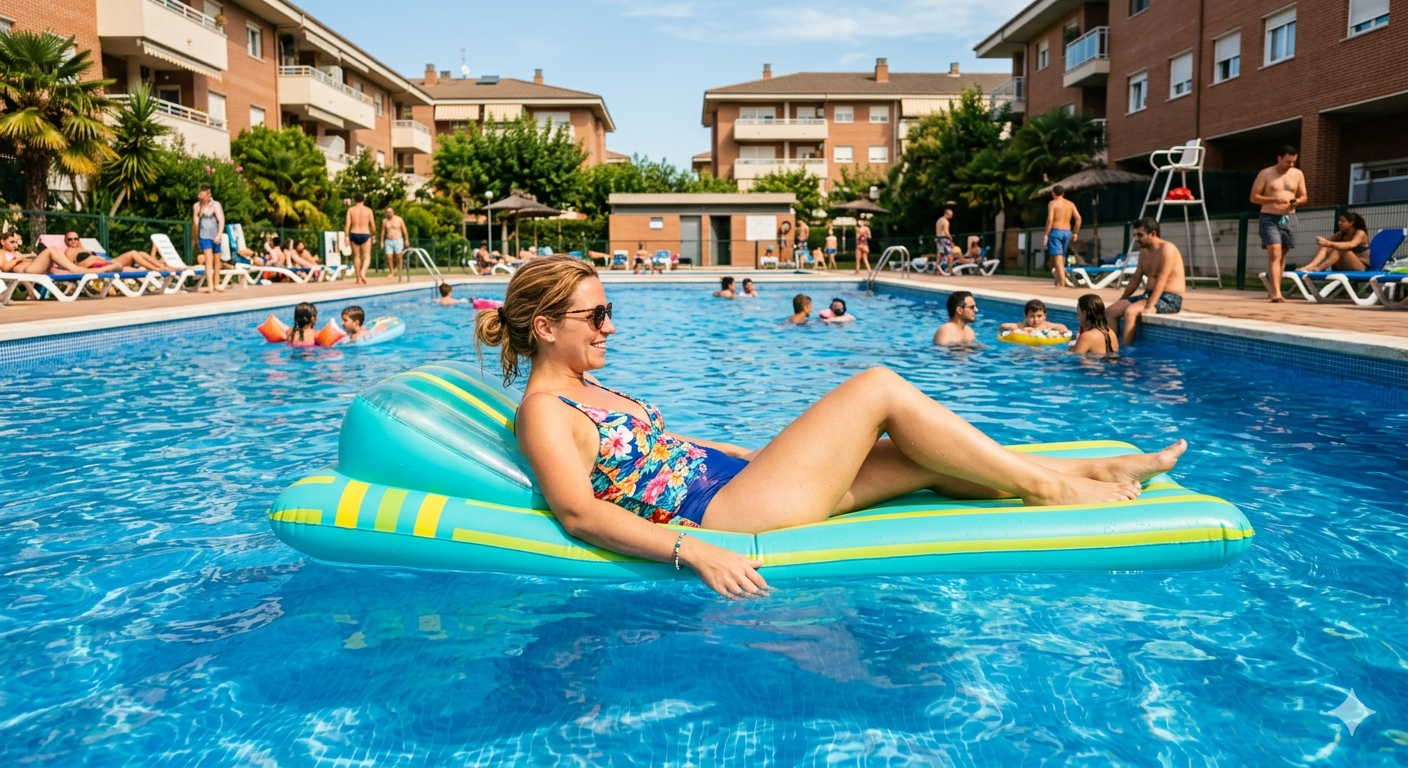
The main reason behind this ban is not a neighborhood whim, but rather the prevention of risks and the safety of swimmers. Large inflatables drastically reduce the visibility of the lifeguards in charge of surveillance and restrict the free movement of users in the water. For this reason, the lifesaving staff has the obligation to ensure strict compliance with these guidelines within their working hours in Spain.

What can the homeowners community do if the pool rules are not respected?

If a neighbor decides to repeatedly ignore the bans on floats or any other rule, the community of owners in Spain has clear legal tools to act, such as issuing a formal warning or taking an injunction action.

  1. Formal warning or request: The community president or the property manager will send a formal letter of complaint or a burofax to the offender. This document officially demands that they cease their prohibited behavior.
  2. Calling an owners’ meeting: If the neighbor ignores the warnings, an extraordinary meeting will be called to discuss the situation. In this meeting, the president must be expressly authorized to initiate legal actions.
  3. Initiation of the injunction action (acción de cesación): With the backing of the meeting, the community will file a lawsuit before the Spanish courts. This legal tool serves to definitively request the termination of the annoying or dangerous behavior.

Can the homeowners community issue fines or sanctions for breaching pool rules?

No, the community of owners does not have the legal authority to impose financial fines or arbitrary financial surcharges on neighbors who violate the pool regulations in Spain. Even if an agreement of this type is unanimously approved at the neighbors’ meeting, it completely lacks legal validity and is null and void by law.

Communities of owners in Spain cannot impose financial sanctions on their members; agreements that establish fines are null and void.

Current legislation strictly distinguishes between a fine and damages for harm or losses. If the improper use of mats or giant floats causes material damage to the residential complex’s facilities, the community will not fine you, but it will legally demand the full payment of the repair cost in Spain.

What can (and what cannot) the homeowners community ban?

Community Action Is it possible to do it? Legal limit or regulation
Ban large mats Yes, by simple majority Internal bylaws in Spain
Impose financial fines No, it is completely illegal Agreement null and void
Cut off electricity or water No, it is considered coercion Leads to criminal proceedings
Limit use to owners in arrears Yes, if stipulated Must be stated in statutes
Demand payment for damages Yes, cost of repair Compensation for material damage
Regularize pool schedules Yes, by simple majority Internal bylaws
Ban pets inside flats No, violates private rights Regulated in private property

Source: Fotocasa’s own elaboration, based on the Spanish Horizontal Property Law

How to act if we want to change the community pool regulations?

If you wish to modify the rules in force to allow or limit the use of floats or mats in the pool this summer, you must formally propose an update of the internal bylaws. Any property owner has the right to present a proposal for change so that it can be debated by the rest of the neighbors in Spain.

Steps and majorities required to update community pool regulations

The first mandatory step consists of requesting the president or property manager to include the detailed modification proposal within the agenda of the next owners’ meeting. It is not valid to make a decision about the pool informally during any other business. Subsequently, the assembly must be called and the prior information sent to all members of the co-ownership.

To successfully modify the internal pool regulations in Spain, it is sufficient to achieve the vote of the simple majority of attendees at the meeting, provided they represent half of the participation shares. Once approval is achieved, the change will be officially recorded in the minutes of the meeting and formally communicated to all residents to guarantee its binding nature. Since it is not a reform of the statutes, this process does not require unanimity nor does it need to be registered in the Land Registry.

When going down to the pool this summer, the smartest option to avoid neighborhood disputes is to check in advance the internal bylaws displayed on the premises. Although small accessories for the safety of children are fully accepted under supervision, giant mats require the meeting’s approval so as not to compromise everyone’s safety in Spain.

If you live in a community with a pool and want to know everything about regulations, hours of use, etc., we recommend our article “Deadlines and regulations for community pools, complete guide”

At Fotocasa, we have an excellent team of professionals dedicated to creating relevant content for our readers. If you enjoyed this article, we would be delighted if you published it on your website. In that case, please remember to credit Fotocasa as the original source. Thank you for your support.

Editorial Integrity of Fotocasa Life

0 Comentarios
Más antiguo
El mas nuevo