
|
What is the best place to live in Spain? We have analysed the map of Spain by combining the latest data on crime, transport and market prices to identify the true real estate safe havens of this year.
From AI-awarded beaches to the best-connected destinations by air: here is everything you need to know before choosing your next location.
Did you know there are provinces where you can buy four homes for the price of just one in the Balearic Islands, while still enjoying top-tier connectivity?
How is Spain divided by regions and provinces in 2026?
Map of the provinces of Spain – Fotocasa
Spain is territorially organised into 17 autonomous communities, two autonomous cities (Ceuta and Melilla), and a total of 50 provinces. This structure creates major differences in lifestyle: from the dynamism of Madrid, as the capital and central hub, and the economic weight of major cities such as Barcelona, to the international appeal of the Balearic and Canary Islands. There are also significant differences in housing prices.
To understand the Spanish map, it is important to know that this is a country defined by diversity and decentralisation: each autonomous community has its own powers in key areas such as housing, healthcare and education, which directly affect taxes and legal procedures in each region. This richness is also reflected in its cultural and linguistic diversity, with several regions where Spanish coexists with co-official languages (Catalan, Valencian, Galician or Basque), giving each territory a unique identity.
Northern Spain map: oceanic climate and stability
In the Cantabrian region and the northwest, the map is defined by an oceanic climate, with mild temperatures and regular rainfall. Provinces such as Lugo (21.7 crimes/1,000 inhabitants) and Ourense not only offer green landscapes, but also rank among the safest areas in the country according to the 2025 crime reports.
Southern Spain map: sun and dynamism
Further south, the Mediterranean and subtropical climate (in coastal areas) drives intense real estate activity. Provinces such as Málaga and Cádiz combine strong connectivity with an outdoor-focused lifestyle, although prices reflect this high demand.
How much does it cost to buy a home in each province of Spain in March 2026?
Housing price map in Spain – Fotocasa
Buying a property in Spain costs, on average, €3,013/m² in March 2026, according to the Fotocasa Property Index. However, prices vary significantly depending on the area. As shown on the map, buying in central Madrid is very different from buying in inland Castilla-La Mancha.
To give you a realistic idea, we have calculated the cost of a standard 80 m² property at both ends of the market: the most expensive and the most affordable provinces.
Overall, the Spanish market is split into two very distinct speeds. The most expensive areas are concentrated in the islands, Madrid, Barcelona and the Basque Country, where tourism pressure and limited supply push prices up. In contrast, the most affordable areas are typically found in the inland regions, in provinces such as Jaén or Ciudad Real, where it is possible to access housing with a much lower investment while still enjoying a good quality of life.
The 5 most expensive provinces to buy a home in Spain in March 2026 (Fotocasa data)
| Province | Price per m² | 80 m² property |
|---|---|---|
| Illes Balears | €5,395/m² | €431,574 |
| Madrid | €5,372/m² | €429,791 |
| Málaga | €4,490/m² | €359,218 |
| Gipuzkoa | €4,458/m² | €356,658 |
| Santa Cruz de Tenerife | €3,725/m² | €298,033 |
Source: Fotocasa Property Index. Prices for March 2026.
The 5 cheapest provinces to buy a home in Spain in March 2026 (Fotocasa data)
| Province | Price per m² | 80 m² property |
|---|---|---|
| Jaén | €1,071/m² | €85,712 |
| Ciudad Real | €1,077/m² | €86,166 |
| Teruel | €1,132/m² | €90,564 |
| Zamora | €1,213/m² | €97,069 |
| Toledo | €1,249/m² | €99,938 |
Source: Fotocasa Property Index. Prices for March 2026.
Map of Spain’s beaches: what are the best beaches in Spain according to AI?
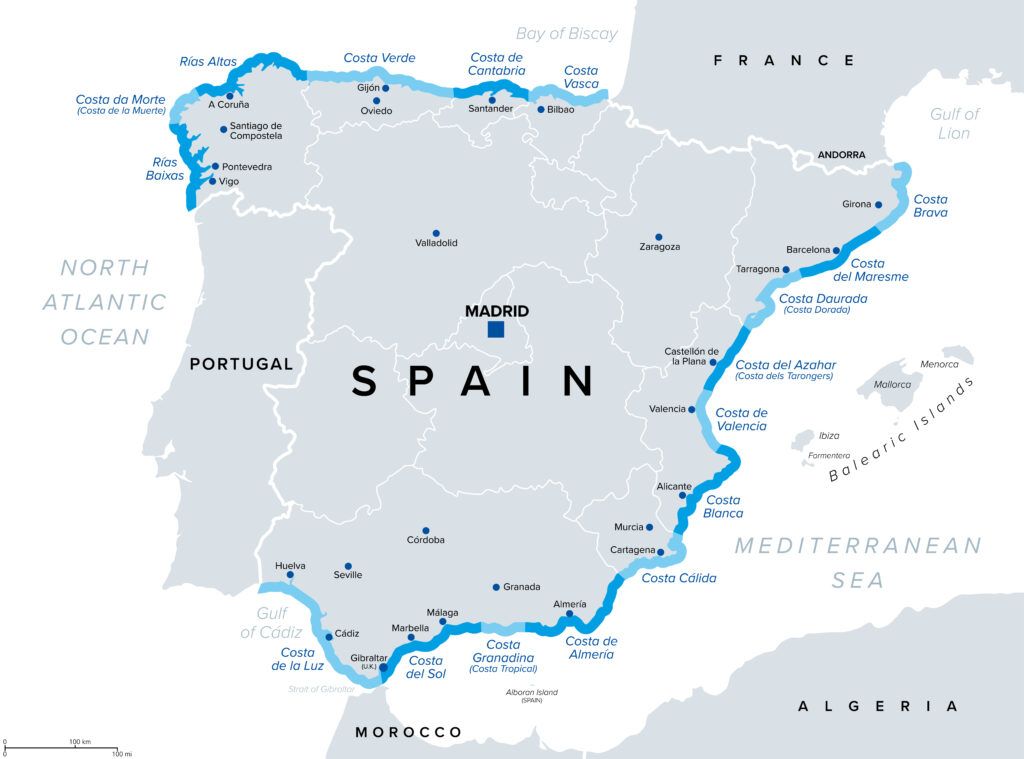
Map of Spain’s coastlines – Getty Images
Playa de Ses Illetes, in Formentera, is the best beach in Spain in 2026, according to ChatGPT AI. It stands out for its turquoise waters and white sand, which have nothing to envy the Caribbean. It is followed by Playa de Bolonia in Cádiz, famous for its wild dune and Roman ruins, and Playa de las Catedrales in Lugo, a natural monument of stone arches that only emerges at low tide.
Spain has one of the most enviable coastal geographies in the world, with almost 8,000 km of coastline, spread across four major areas:
-
Cantabrian Coast: Green landscapes and cliffs (North).
-
Atlantic Coast: Wild beaches and dunes (Galicia and Cádiz).
-
Mediterranean Coast: Rocky coves and long sandy beaches (East and South).
-
Archipelagos: Volcanic paradises (Canary Islands) and crystal-clear waters (Balearic Islands).
Ranking: the 20 best beaches in Spain in 2026 according to AI
| Rank | Beach | Province |
|---|---|---|
| 1st | Playa de Ses Illetes | Illes Balears |
| 2nd | Playa de Bolonia | Cádiz |
| 3rd | Playa de las Catedrales | Lugo |
| 4th | Cala Macarella | Illes Balears |
| 5th | Playa de Rodas | Pontevedra |
| 6th | Cala Comte | Illes Balears |
| 7th | Playa de Cofete | Las Palmas |
| 8th | Playa de la Concha | Guipúzcoa |
| 9th | Cala Mitjana | Illes Balears |
| 10th | Playa de Muro | Illes Balears |
| 11th | Cala Sa Boadella | Girona |
| 12th | Playa de los Genoveses | Almería |
| 13th | Cala Saladeta | Illes Balears |
| 14th | Playa de Papagayo | Las Palmas |
| 15th | Cala Aiguablava | Girona |
| 16th | Zahara de los Atunes | Cádiz |
| 17th | Cala Pola | Girona |
| 18th | Playa de Oyambre | Cantabria |
| 19th | Cala Pregonda | Illes Balears |
| 20th | Maspalomas | Las Palmas |
Source: ChatGPT. Data consulted in April 2026.
The map of tranquillity in Spain: which are the safest provinces to live in?
Safety Map of Spain – Fotocasa
Living in a safe area is the number one priority for many families. If we cross-reference population data with the latest Crime Report from the Ministry of the Interior (2025), we can see that inland Spain and some northern provinces are true havens of peace.






 Your home in Spain