Furthermore, you should bear in mind that banking institutions in Spain usually grant non-residents between 60% and 70% of the property’s appraisal value—which they carry out themselves—rather than the market price. This forces foreign buyers to have a larger amount of prior savings than local residents.
Comparing mortgages and requesting a pre-approval will save you time and frustration by preventing you from falling in love with properties that exceed your actual financial capacity. In addition, presenting a mortgage pre-approval letter positions you as a serious and attractive buyer, increasing the chances of your offer being considered.
3. Failing to account for taxes and extra expenses when buying a home in Spain
A critical mistake made by many foreigners who want to buy a house in Spain is not calculating the taxes and expenses directly linked to the time of purchase, which usually represent an extra 10% to 12%. Foreigners pay exactly the same taxes as a Spanish citizen, but these vary depending on the type of property and the autonomous community:
- Second-hand homes: These are subject to the Property Transfer Tax (ITP). This tax ranges between 6% and 10% of the purchase price, and can reach up to 13% in some autonomous communities for luxury properties.
- New-build homes: These are subject to a 10% VAT (IVA) on the sale price (reduced to 4% for officially protected housing or VPO). In addition, the Stamp Duty (IAJD) must be paid, which varies between 0.5% and 1.5% if the purchase is made in cash, since if a mortgage is requested, this cost is covered by the bank.
- Notary fees: These cover the drafting of the public deed of sale. Their cost varies according to the price of the house and usually represents between 0.2% and 0.5% of its value.
- Land Registry: This is the fee derived from registering the property under the new buyer’s name. It is calculated in tiers according to the deeded price (for example, around €133 for a €100,000 home).
- Appraisal and agency fees: Property appraisal is mandatory if you apply for a mortgage, and its cost ranges between €250 and €600. You must also consider the agency fees for managing the administrative procedures of the sale.
4. Ignoring the costs of running a property in Spain: another basic mistake when buying a home in Spain
Owning a property in Spanish territory entails a series of recurring expenses that must be anticipated to avoid putting your financial health at risk. The most important annual and monthly fixed costs for maintaining a house in Spain are:
- Property Tax (IBI): An annual mandatory municipal tax that usually ranges between 0.4% and 1.3% of the cadastral value.
- Rubbish collection fee: A municipal tax for waste collection that averages around €116 per year.
- Community fees and extraordinary levies: If the flat is part of a residential development or building, the maintenance of the common areas averages around €100 per month. Extraordinary levies must be reviewed before signing to avoid unexpected payments for structural repairs.
- Non-Resident Income Tax (IRNR): Mandatory for foreign non-residents in Spain. If the house is not rented out, the tax authorities apply a tax on an imputed theoretical income. If it is rented out, a rate of 19% applies to residents of the EU, Iceland, or Norway (with expense deductions) and 24% for the rest of countries (without deductions).
Expenses when buying a property in Spain
| Type of Expense |
New-Build Property |
Second-Hand Property |
| Purchase Tax |
VAT (10% general) + Stamp Duty (0.5% to 1.5%) |
Property Transfer Tax (6% to 10% depending on the autonomous community) |
| Processing Fees |
Notary (0.2%-0.5%) and Land Registry |
Notary (0.2%-0.5%) and Land Registry |
| Annual Taxes |
IBI (0.4% to 1.3% cadastral) and Rubbish Fee |
IBI (0.4% to 1.3% cadastral) and Rubbish Fee |
| Recurring Expenses |
Community Fees (approx. €100/month) + Utilities |
Community Fees (approx. €100/month) + Utilities |
Source: Fotocasa
The final percentages of the property transfer taxes and stamp duties vary depending on the Autonomous Community where the property is located.
5. Failing to request the Nota Simple or the Certificate of Occupancy
Buying a house in Spain without requesting an updated Nota Simple from the Land Registry is dangerous, as you could automatically inherit the mortgages or community defaults left by the previous owner.
Likewise, the Certificate of Occupancy (Cédula de Habitabilidad) is mandatory in order to connect water and electricity utilities. Many foreigners, for instance, buy idyllic country houses without knowing that they are built on rustic land (suelo rústico).
6. Not thoroughly researching the neighborhood or comparing areas: one of the most common mistakes made by foreigners
Not all areas within the same city are equal. Visiting a coastal town or a large city during a short holiday offers a very biased picture of reality. It is a very common mistake when buying a home in Spain not to check health services, schools, public transport, or commercial activity during the low season or winter.
To avoid making a mistake, it is essential to carry out a comprehensive search. In the Fotocasa search engine, you can filter properties by specific areas and compare market prices of similar homes in the neighborhood to ensure you get a fair value.
7. Being afraid to negotiate the sale price
This mistake is very common due to shyness or unfamiliarity with Spanish commercial customs, and it is something buyers often regret over time. You should never be afraid to negotiate the price of the property, as it is a common practice in Spain. Proposing a counter-offer based on solid arguments—such as the condition of the property, necessary renovations, or the prices of similar homes on the same street—can result in a very significant cost reduction.
8. Not having the support of an expert real estate agency
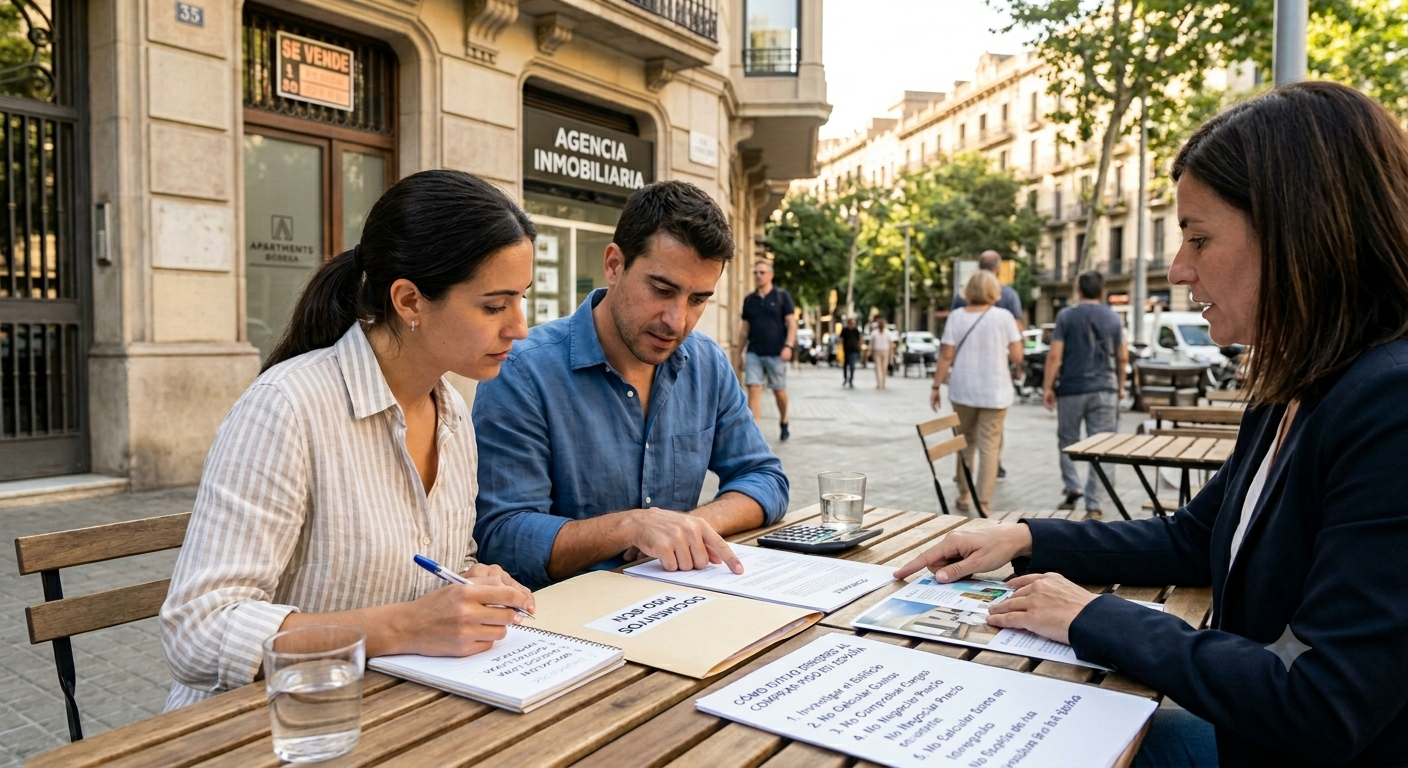
A professional real estate advisor who knows the area will be of great help to guide you through the Spanish legal and bureaucratic process. An agency will help you screen the best properties, advise you on prices and the best areas according to your needs, mediate objectively in the final price negotiation, verify that all documentation is in order, and accompany you with full security guarantees until the day of signing the public deed before the notary.
9. Not budgeting for the cost of renovations and moving
Buying a flat that needs improvements without calculating the cost of the building works beforehand can completely disrupt your budget. It is highly recommended to carry out a prior technical inspection with a professional to identify hidden defects in the property before signing the transaction.
To this, you must add the logistical expenses of the move, which in the case of foreign buyers usually require specialized companies and long-distance transport of belongings.
10. Failing to apply for the NIE or open a bank account in Spain in advance
Can you imagine finding the flat of your dreams, only for someone to beat you to it because you didn’t have your paperwork ready? If you are thinking of buying a house in Spain, you are going to need a NIE and a Spanish bank account for almost everything. These procedures, while relatively straightforward, can take time. If you are already clear that you want to move to Spain, we recommend that you get this paperwork sorted out as soon as possible.
The NIE can be requested in Spain, at Foreigners’ Offices (Oficinas de Extranjería) or certain authorized Police Stations, or from abroad through your Spanish Consulate.
Regarding bank accounts, there are currently many bank accounts in Spain that can be opened free of charge and 100% online.
What pitfalls should you avoid if you are going to buy a property in Spain as a foreigner?
The most serious mistakes when purchasing a property in Spain from abroad are not validating financing in advance, not knowing the taxes when buying a home in Spain or future maintenance expenses, buying blindly without knowing if the property has all the regulatory documentation, failing to present counter-offers, and not knowing the area well.
In addition, we recommend not leaving all procedures until the end and requesting your NIE and opening your Spanish bank account in good time to avoid delaying deadlines or missing out on offers.
If you are thinking of moving to Spain, a local real estate agency can accompany you throughout the process and advise you on the best options for you.
Did the article help you? Help me by rating it with 5 stars.








 Your home in Spain