How does the drought affect private pools in Andalusia this Summer 2026?

Fotocasa is the expert real estate portal if you are looking for your home in Spain and want to resolve your doubts about housing

Patricia Andrés
Patricia Andrés Experta en el sector inmobiliario

Promedio de puntuación 5 / 5. Recuento de votos: 1

Hasta ahora, ¡no hay votos!. Sé el primero en puntuar este contenido.

  • In March 2026, the Junta de Andalucía officially declared a return to normal water levels across all its river basins.
  • The filling and refilling of private swimming pools is permitted at a regional level, with specific enforcement delegated to individual local town hall decrees.
  • Despite the improved situation, authorities require the use of recirculation systems and rational consumption to prepare for future droughts.

The threat of dry taps and empty pool covers that worried Andalusian property owners in recent years seems to have completely vanished ahead of this summer. The winter, marked by heavy storms and rain fronts, has replenished Andalusia’s water reserves, allowing the region to return to normality.

In this article, we will analyze whether it is legally permitted to use and refill private pools in Andalusia this year, in 2026. At Fotocasa, we explain the current state of the reservoirs and the technical requirements in place so you know exactly what to expect before taking your first dip.

What exact water restrictions must you comply with on your property to open your pool for the swimming season this year?

Can Private Pools Be Filled in Andalusia in 2026?

Yes, this summer 2026, filling and refilling private and community swimming pools is permitted at a general regional level throughout Andalusia. The Ministry of Agriculture, Fishing, Water, and Rural Development formally approved the transition to a “normal situation” for all water management systems that were previously under severe restrictions. This means that regular water consumption rights and operations have been fully restored.

The end of regional restrictions hands water management back to local town halls, which will closely monitor excessive water consumption. If we own a property with a private swimming pool in Andalusia, we will need to check local municipal regulations.

At a regional level, the regional administration has lifted the general prohibitions that were in place in the past. However, Spanish regulations stipulate that direct competencies over domestic supply and the use of drinking water in urban environments belong to the town halls. Therefore, if we own a property in Andalusia with a private swimming pool, we must specifically check the municipal decrees and local ordinances of our town or city in case there are specific limitations in specially regulated areas.

What Are the Mandatory Technical Requirements for Pools in Andalusia?

Although filling is authorized on a general basis, any swimming pool in Andalusian territory must strictly comply with a series of technical conditions to guarantee environmental sustainability:

  • Recirculation systems: It is mandatory for the facility to have an active water treatment and recirculation system, designed to minimize the need to renew the total volume of the pool shell.
  • Prohibition of emptying: Unjustified annual emptying is restricted unless structural repair or deep sanitary disinfection reasons are alleged.
  • Local sanctions: The improper use of drinking water or refilling while bypassing local decrees can lead to municipal fines ranging between €30 and €1,800.

How Has the Situation of Andalusian Reservoirs Evolved After the Drought?

The technical reports presented by the Drought Management Commissions confirm that the autonomous community’s water reserves are well above alert thresholds. From recording absolute historical minimums in October 2024 (where Málaga’s reserves plunged to 15.5%), the situation has shifted to a scenario of absolute tranquility thanks to a winter of continuous storms and rain fronts at the start of this year, 2026.

Systems that were on the verge of collapse, such as the La Viñuela reservoir in the Axarquía, have far exceeded the normality limits set in the Special Drought Plan. This express recovery has even allowed the resumption of resource transfers that had been suspended for five years, guaranteeing the supply for both the tourism and agricultural sectors.

Hydrological Status and Pool Regulations by Water District in 2026

Basin / System Water Status Pool Filling
Guadalete-Barbate Normality (92% capacity) Permitted (municipal decree)
Mediterranean Basins Normality (76.9% capacity) Permitted (municipal decree)
Tinto-Odiel-Piedras Normality (no changes) Permitted (municipal decree)
Viñuela-Axarquía System Normality (148.63 hm³) Permitted (municipal decree)

Source: Ministry of Agriculture, Fishing, Water, and Rural Development of the Junta de Andalucía, March 2026.

How Can I Optimize Water Savings in My Private Pool?

The main recommendation from professionals is to avoid emptying the pool annually and to opt for continuous chemical maintenance throughout the year. Keeping the same water in the pool shell for a period of 4 to 6 years is perfectly viable if correct disinfection and filtration guidelines are followed.
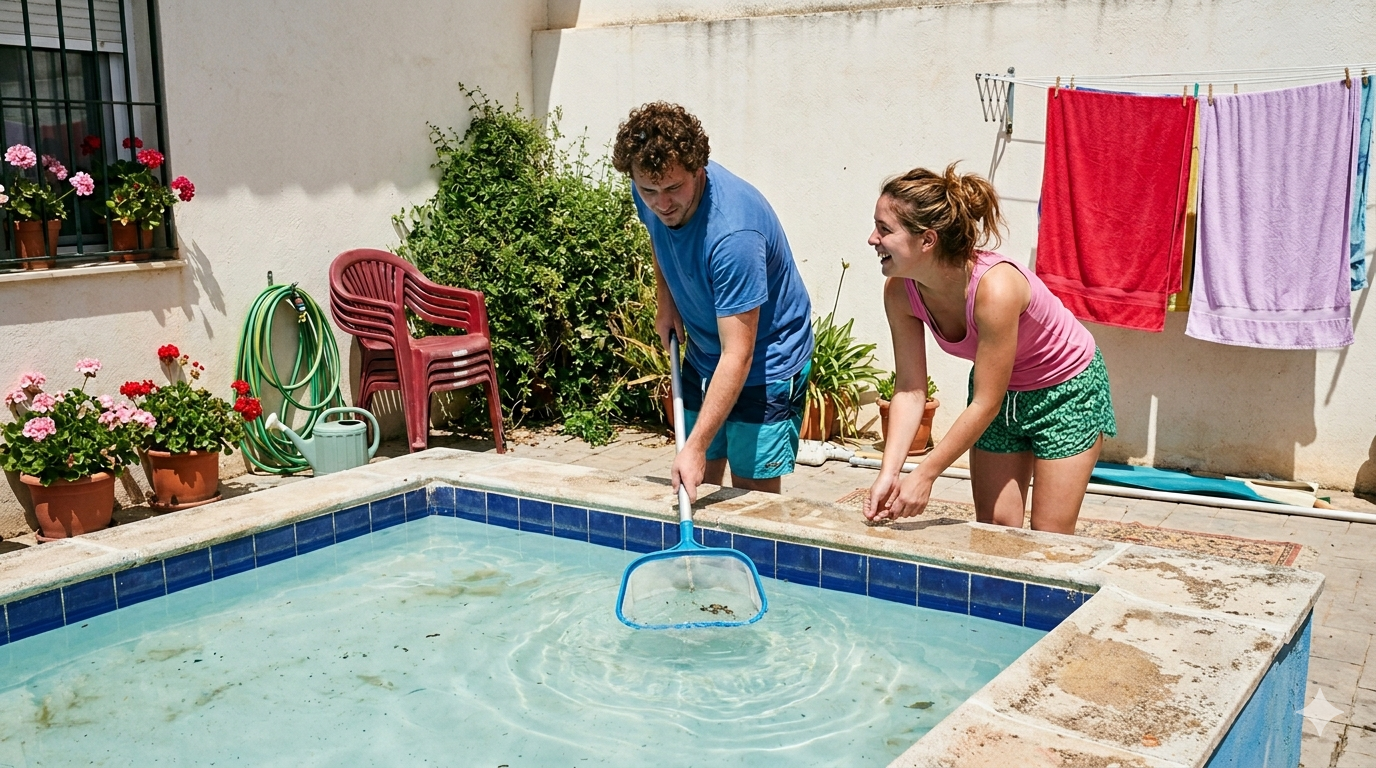

The water consumption of the more than 1.2 million swimming pools in Spain represents less than 1% of the total water supplied nationwide.

Optimizing our pool’s water not only reduces environmental impact but also significantly lowers the cost of domestic water bills. Small changes in the maintenance routine generate big long-term savings.

Tips to Avoid Wasting Water in Your Private Pool

  1. Install a solar cover: putting a cover in place reduces water evaporation by up to 95%, besides protecting the pool shell from external dirt and preserving the optimal temperature for swimming.
  2. Automate filtration: scheduling the treatment plant and salt chlorination systems for the first or last hours of the day prevents direct solar radiation from evaporating chlorine and chemical additives.
  3. Wash filters only when necessary: clean the sand filters only when the pressure gauge indicates high pressure. You can also use efficient technologies such as filter balls or glass, which reduce the need for constant washing.
  4. Reuse backwash water: the volume of water expelled during filter cleaning can be safely stored to wash outdoor pavements or water areas of the garden.
  5. Make use of rainwater: implementing a rainwater harvesting system on roofs allows you to offset the natural drop in water levels caused by summer heat, after a prior analysis of its pH.

The return to normal water levels in Andalusia is a relief for the residential market, the vacation rental sector, and tourism this summer 2026.

However, the lesson from the last five years of extreme drought must remain fresh in the collective memory. Having sufficient resources today does not justify waste, as authorities already warn that climate change dynamics will force us to face new periods of scarcity in the future.

Enjoying your private pool sustainably, equipping it with covers and optimizing its filters, is the best roadmap to protect your property’s value and safeguard the environment.

At Fotocasa, we have an excellent team of professionals dedicated to creating relevant content for our readers. If you enjoyed this article, we would be delighted if you published it on your website. In that case, please remember to credit Fotocasa as the original source. Thank you for your support.

Editorial Integrity of Fotocasa Life

0 Comentarios
Más antiguo
El mas nuevo